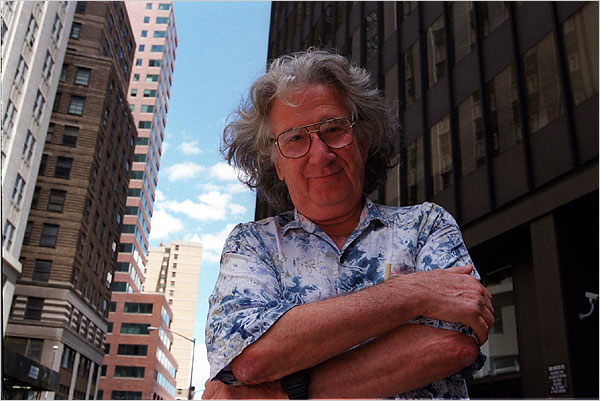
Interview with Augusto Boal about Rainbow of Desire
Mette Bøe Lyngstad and Stig A. Eriksson;
- from Europe to South-America
Augusto Boal: Forum theatre came to life in Peru, and then of course I perfected it a little bit. When I came to Europe, the first thing that they told me was that "oh yes, that’s very good for Latin America, but here the situation is different” And then we saw that it is not much different at all; the mechanics of the Forum theatre is for everyone, it is not only for the people in Peru, it is for people in Europe too. Here in Europe I started developing the Rainbow of desire series. Now we have 15 techniques of the Rainbow of desire. The initial techniques were developed in Europe (and here in Scandinavia). Then I went back to Brazil, where I went on developing the other techniques. Now we do Rainbow of desire all over the world; and my son Julian has done it too, in India. I don’t believe that once you discover something, it is only good for that one thing. If it is only good for that, it is circumstantial and it is going to disappear very soon, because that reality will also change. The techniques that we developed are not going to die tomorrow, because they do not come impregnated by the specific conditions of Peru or Scandinavia. They come as a structure, and you are discussing themes in the group with which you use them. For instance in Brazil, I had not seen drugs before, and I had not talked about drugs or the violence of drug gangs. But now, in Rio if you do four plays, at least one will be about drugs, and at least one will be about police violence. So the themes change, but the mechanics are the same. Like if I learn English, I can talk about anything. I can talk about metaphysics, I can talk about history, I can talk about science, because I have the language. The discourse, the speech you want to make, needs a language. So you learn that language and use it to the needs of your group.
Some people will say that the Rainbow of desire direction in your work is
close to therapy; how would you comment on that?
Augusto Boal: My comment is that theatre is therapeutic, it is not therapy but it is therapeutic. I think that is so for all of you; if you do theatre it is good for you. And the theatre of the oppressed is dynamic theatre, it is not static. It allows people to go and try, and to try again a third and a fourth time - and this is extremely therapeutic. Forum theatre is therapeutic. When you come here and you exert it, it is therapeutic. It does good for you, because the fact that you made the transgression and took part, makes you stronger. It makes you a person who does not accept the fiction of the reality here, and that’s good. It is therapeutic, but it is not a therapy. Therapy assumes that you have a psychological problem and a need for treatment. Therapy also assumes that there is a therapist, a person who knows better than us.
Where is the borderline between being educational and therapeutic?
Augusto Boal: I do not believe in a borderline there, I think there is an overlapping.I believe that if you do Hamlet sincerely and well, it is therapeutic for the actor. It can also make him sick if it is not well done,
but it is therapeutic.
Is it a different theatre work in the Rainbow of desire than in the Theatre of the oppressed?
Augusto Boal: I think the techniques of the Rainbow of desire are more complex. Really, if you look at the Forum, it is simplicity itself. You make a scene, with a protagonist and you show what to do; basically that is it. You can for example have ideas about how to use music, but it is still relatively simple. However, if you do techniques from the Rainbow of desire, it is much more complex, and it takes much more time to do it. That is because it is much more difficult to make theatre from what is hidden in your mind, maybe hidden from yourself. You do not know, so you have to go through regions in your head, which are not clear to yourself. So it is more difficult, more complex, but it is theatre. I always insist: I am a man of the theatre. I am not a therapist, I am not a pedagogue, but of course theatre is therapeutic. Of course theatre is pedagogy, of course theatre is politics above all - politics in the sense that whatever we do here, is not to stay here. Whatever we do here, we will go out and do in real life. Whatever we learn here is to be extrapolated. To be a citizen is to change society. To be a citizen is to help make society better. The Theatre of the oppressed can help with this. I think that all forms from Rainbow of desire should go to Forum theatre, and then Forum theatre should go into the real world. What we do here is also real life, but I mean to life outside the Forum. All forms of Rainbow of desire are ways of externalising the oppression that you have internalised, but it is necessary to have a go at the reality outside, too. It is not to cure yourself, it is to teach yourself what the authoritarian education prevented you from learning. I say that inside ourselves we have killers, that is why we can play Macbeth. Inside ourselves we have melancholy, that is why we can play Hamlet. But we have good things also inside that can help us. The authoritarian education strangled those things, but they are still alive inside of us. Many characteristics that can be useful for us are sleeping there. The Theatre of the oppressed can bring those characteristics out.
What are the most important challenges for the joker?
Augusto Boal: The joker has the most responsibility in coordinating the creators, because everyone has to be involved creating. As the joker you have the responsibility to coordinate all the creations and the creators. But you also have to take care not to impose your own view. You are not superior to anybody. You have your opinion, you have your intelligence, you can have all the qualities you have, but you never say I am like this or I have more knowledge of this; that is the basics of it. Why is it called the joker? In Portuguese it is "coringa" , in Spanish "comodin", but in English, unfortunately, joker also relates us to joking. We say "jokering" and not joking, because it means the white card. A joker, a real joker, is a person who can help the people write a play, help people do the blocking of the play, help the people with the music, with the text, with everything. That is the white card, so the responsibility is to learn more and more and know more and more, so that you can teach in many ways. That is a bigger responsibility. But you have to teach in a democratic way, to respect the other ones. When the audience want to discuss what they think, the joker’s responsibility is a moral responsibility above all. It is important not to use this privileged position to impose ideas, because it is a privileged position. It is like when I am in a privileged position here, and Julian is in a privileged position here, because you invited us. So we have come here, and we are supposed to know something. Maybe we do know it, maybe we do not; but supposedly we know everything about uses of our theatre forms - and it is not true. Today I learned that here in Norway you are using Forum theatre for children 4 and 5 years old. I had not heard about that before: How can you do Forum theatre with so young children? How do they react? I would love to see a film about using Forum theatre for children of 4 and 5 years. I have never seen that. But you have done it here! Now I can tell everyone: Look, I am sure you can do Form theatre for 4 year olds. If it is possible in Norway, then it is a possible in Brazil, too. So I shall take this back to Brazil! Thank you…
The interview took place at Høgskolen i Bergen (Bergen University College), November 4th 2003. It has been transcribed from video tape by Jørn Lavoll.
Sitater:
So the themes change, but the mechanics are the same.
To be a citizen is to change society. To be a citizen is to help make society better. The Theatre of the oppressed can help with this.
Today I learned that here in Norway you are using Forum theatre for children 4 and 5 years old. I had not heard about that before: How can you do Forum theatre with so young children?
Now I can tell everyone: Look, I am sure you can do Form theatre for 4 year olds. If it is possible in Norway, then it is a possible in Brazil, too.
Tuesday, December 8, 2009

Practice - Invisible Theater
Invisible theatre is a form of theatrical performance that is enacted in a place where people would not normally expect to see one, for example in the street or in a shopping centre. The Brazilian Theatre practirioner Augusto Boal developed the form during his time in Argentina in the 1970s as part of his Theatre of the Oppressed, which focused on oppression and social issues. Boal went on to develop forum theatre. Invisible theatre can give people who would not normally have the chance to see plays the opportunity to do so—or, as is often the case, it can be performed without the knowledge of its audience, which in such a scenario would consist of whoever happens to wander by. This can be done in order to help actors make a point publicly in much the same motivational vein as graffiti or political demonstration, or it can be done in order to help actors gain a sense of what a realistic reaction might be to a certain scenario; for example, a heated argument over a political or social issue. This type of theatre is performed in public on unexpected bystanders, whom the actors will try to get unknowingly involved in the scene.
(Wikipedia)
(Wikipedia)
Practice - Newspaper Theater
A system of eleven techniques which give the audience a way to create a production rather than viewing a finished artistic piece. The techniques are devised to help anyone to make a theatrical scene using a piece of news from a newspaper, or from any other written material.
1. The simple reading
2. The complementary reading
3. The crossed reading
4. The rhythmical reading
5. The reinforced reading
6. The parallel action
7. The historical reading
8. Improvisation
9. The concretion of abstraction
10. Text out of context
11. Insertion into the actual context.
1. The simple reading
2. The complementary reading
3. The crossed reading
4. The rhythmical reading
5. The reinforced reading
6. The parallel action
7. The historical reading
8. Improvisation
9. The concretion of abstraction
10. Text out of context
11. Insertion into the actual context.
Practice - Forum Theater
Forum Theater provides an innovative approach to public forums and is at the core of the Theater of the Oppressed. It is the form most widely used by educators and by community and labor organizers in work with their constituency. Forum Theater has been used by organizers and educators worldwide for democratizing their own organizations, analyzing problems and preparing for action.
In Forum Theater, participants determine what their priority issues are--usually problems from everyday life--and develop short themes. Role-playing serves as a vehicle for analyzing power, stimulating public debate and searching for solutions. Participants explore the complexity of the individual/group relation at a variety of levels of human exchange. They are invited to map out: a) the dynamics of power within and between groups; b) the experience and the fear of powerlessness within the individual; and c) rigid patterns of perception that generate miscommunication and conflict, as well as ways of transforming them. The aim of the forum is not to find an ideal solution, but to invent new ways of confronting problems. Following each intervention, audience members discuss the solution offered. The experience has been called a “rehearsal for life.”
Legislative Theater, which pushes Forum Theater a step further, is Boal’s most recent innovation. In 1992, Boal was elected on a Workers Party slate to the Chamber of Vereadores (similar to a City Council in the United States) of Rio de Janeiro. Once installed in office, he adapted his theater techniques for use in city politics, with some hilarious--and sometimes rancorous--results. He hired his theater group as his legislative staff and extended their methods of participatory theater into the realm of government by creating seventeen companies of players in communities throughout the city. This method of governing came to be called legislative theater in which ordinary people, usually restricted to the role of voters, were encouraged to become legislators. Brazil now has 13 laws that were created in legislative-theater forums, and experiments in legislative theater-type work have since taken place in London, Toronto, Munich, and Paris.
In Forum Theater, participants determine what their priority issues are--usually problems from everyday life--and develop short themes. Role-playing serves as a vehicle for analyzing power, stimulating public debate and searching for solutions. Participants explore the complexity of the individual/group relation at a variety of levels of human exchange. They are invited to map out: a) the dynamics of power within and between groups; b) the experience and the fear of powerlessness within the individual; and c) rigid patterns of perception that generate miscommunication and conflict, as well as ways of transforming them. The aim of the forum is not to find an ideal solution, but to invent new ways of confronting problems. Following each intervention, audience members discuss the solution offered. The experience has been called a “rehearsal for life.”
Legislative Theater, which pushes Forum Theater a step further, is Boal’s most recent innovation. In 1992, Boal was elected on a Workers Party slate to the Chamber of Vereadores (similar to a City Council in the United States) of Rio de Janeiro. Once installed in office, he adapted his theater techniques for use in city politics, with some hilarious--and sometimes rancorous--results. He hired his theater group as his legislative staff and extended their methods of participatory theater into the realm of government by creating seventeen companies of players in communities throughout the city. This method of governing came to be called legislative theater in which ordinary people, usually restricted to the role of voters, were encouraged to become legislators. Brazil now has 13 laws that were created in legislative-theater forums, and experiments in legislative theater-type work have since taken place in London, Toronto, Munich, and Paris.
Monday, December 7, 2009
Practice-Image Theater
Image theatre begins with movement to achieve a static result. Participants are asked to 'mold' and 'sculpt' their own bodies or those of others into individual representations of a particular situation, emotion, or idea, and then move into a group and re-form the images they have created to form a picture or 'image'. Boal's philosophy behind this form of theatre is that the body is the first and primary method of expression, and by using the body rather than speech, the normal 'blockades' and 'filters' of thought can be bypassed. Boal encourages the participants to immediately create an image rather than think about it, as thought would defeat the purpose of expressing raw, unrefined perceptions on an idea or issue. Generally, this form of theatre is also used to express oppressions.
Image theatre is also dialectic, as those who view the image created are also able to sculpt the bodies of the participants to portray their opinions on the issue. This process is repeated until a general consensus is found, in which all are content that the image is an accurate representation.
In keeping with Boal's philosophy of theatre for empowerment, the 'ideal image', in which the oppression is overthrown, may also be created. This is followed by an 'image of transition' between the reality of the oppression and the ideal image, to encourage insight into ways of overthrowing the oppression in reality.
Image Theater includes a variety of workshops designed to develop individual skills of observation and cooperative group interaction. In Image Theater, the body is used to create images that help participants explore power relations and group solutions to concrete problems.Some of the most widely used workshops in the image theater repertory include:
Cop-in-the-Head: an introspective technique used to recognize and confront internalized forms of oppression. The workshop begins with someone recounting a personal experience of oppression, and then gradually goes from the particular to the general. In the end, the group, and not the original story teller, has become the protagonist.
Rashomon: an improvisatory technique inspired by filmmaker Akira Kurosawa's study in multiple perspectives. It is used to highlight the role of perception in the creation of the “Other,” and is specifically designed for the study of rigid patterns of perception that give rise to distorted, incomplete, or mistaken impressions of others, and ultimately hatred, in closed, recurring situations.
Image theatre is also dialectic, as those who view the image created are also able to sculpt the bodies of the participants to portray their opinions on the issue. This process is repeated until a general consensus is found, in which all are content that the image is an accurate representation.
In keeping with Boal's philosophy of theatre for empowerment, the 'ideal image', in which the oppression is overthrown, may also be created. This is followed by an 'image of transition' between the reality of the oppression and the ideal image, to encourage insight into ways of overthrowing the oppression in reality.
Image Theater includes a variety of workshops designed to develop individual skills of observation and cooperative group interaction. In Image Theater, the body is used to create images that help participants explore power relations and group solutions to concrete problems.Some of the most widely used workshops in the image theater repertory include:
Cop-in-the-Head: an introspective technique used to recognize and confront internalized forms of oppression. The workshop begins with someone recounting a personal experience of oppression, and then gradually goes from the particular to the general. In the end, the group, and not the original story teller, has become the protagonist.
Rashomon: an improvisatory technique inspired by filmmaker Akira Kurosawa's study in multiple perspectives. It is used to highlight the role of perception in the creation of the “Other,” and is specifically designed for the study of rigid patterns of perception that give rise to distorted, incomplete, or mistaken impressions of others, and ultimately hatred, in closed, recurring situations.
Subscribe to:
Posts (Atom)